Kinnauri Culture Beyond the Topi
Kinnaur is often flattened into caps, apples, and views of Kinner Kailash. Its real appeal is more precise: mixed ritual worlds, strong village identity, wood-and-stone aesthetics, and a society that still reads season very carefully.
By Himalayan Locals Editorial Team
The Kinnauri cap is memorable because the culture behind it is memorable. The mistake is stopping at the symbol. Kinnaur deserves a slower reading through village form, ritual coexistence, weather discipline, and the old seriousness with which the district holds itself.
This is one of the most distinct mountain societies in Himachal, and one of the easiest to oversimplify. Hindu and Buddhist influences, sharp regional variation, wool work, and a very particular village dignity give Kinnaur its character.
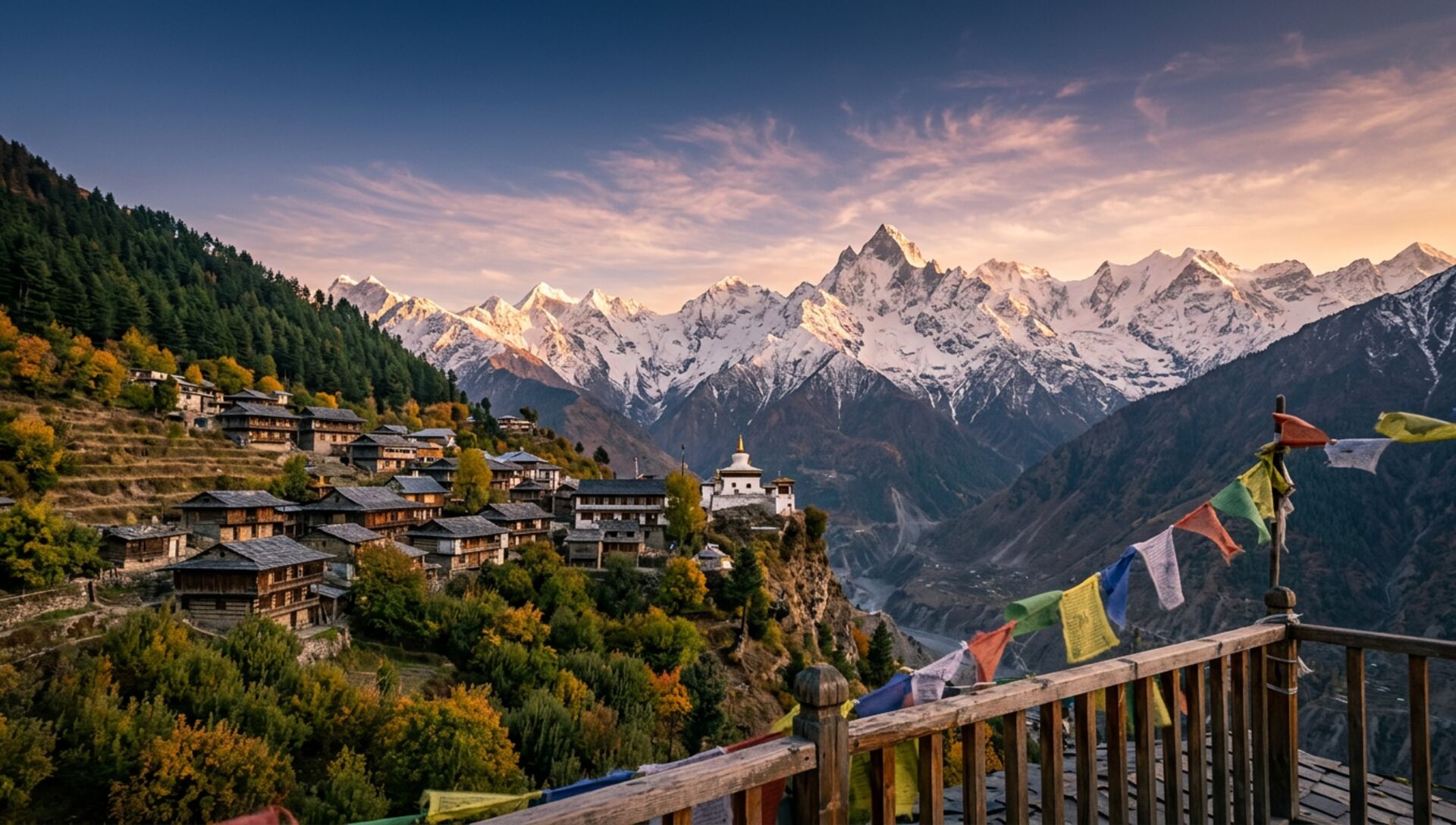
Why the Kinnauri story changes the trip
The right Kinnaur trip is not only a road to viewpoints. It is a route through settlements that still feel architecturally and socially specific. Even when the district gets visually dramatic, the culture does not disappear behind the mountains. In good planning, it becomes even more visible.
The details that still make Kinnaur feel alive
- A culturally distinctive district where ritual worlds meet rather than cancel each other.
- Strong village identity expressed through dress, built form, and seasonal behaviour.
- A better reason to linger in Kalpa, Sangla, or nearby settlements than simply chasing landscapes.
- An example of why inner-Himachal travel rewards local attention more than standard sightseeing habits.
When this journey feels most worth doing
Kinnaur is readable across several seasons, but the clearest travel windows are the ones where roads behave well and villages are easy to inhabit slowly. Post-monsoon often feels especially sharp, while spring can bring a softer valley texture.
What Kinnaur gives you beyond the obvious
The strongest version of this journey is rarely the one that tries to see the most in the least amount of time. It is the one that allows Kinnauri life in Kinnaur to become legible through repetition: one more walk, one more meal, one more conversation, one more hour spent noticing how the place holds itself when nobody is trying to impress you.
That is usually where the copybook idea of culture falls away and the real thing begins. You stop looking for a headline and start noticing pattern, mood, labour, and social intelligence. In Himalayan travel, that shift is often the difference between a pleasant route and a memorable one.
Why Kinnauri landscapes should not be consumed too quickly
Most travellers get this wrong in the same way: they arrive with a collecting instinct. They want one clean explanation, one culturally satisfying photograph, one short answer to what this region means. But Kinnaur is not built to reward that kind of speed. It asks for sequence, patience, and enough humility to let local life stay larger than your interpretation of it.
- Do not treat Kinnaur as a rare detour whose job is to deliver proof of authenticity.
- Do not confuse visual difference with cultural understanding.
- Do not let road ambition erase the slower social texture that makes Kinnauri life meaningful in the first place.
Travel like a guest, not a collector
Do not over-drive the district. Stay in at least one village zone long enough to feel mornings and evenings. Ask about local architecture, woollens, food, and ritual spaces. The district is not improved by speed.
For travellers who care about quality, the real upgrade is subtle. Better timing, fewer unnecessary stops, stronger local hosting, and more emotional space create a route that feels calmer and far more expensive in the right way. That is especially true in Kinnaur, where the atmosphere improves the moment the itinerary stops trying to prove itself.
Trips that pair well with this cultural angle
- Kinnaur Valley Route: The best direct fit for travellers who want Kinnaur itself, not just the road through it.
- Kinnaur-Spiti Continuation: Useful if you want to compare how neighbouring Himalayan regions hold culture differently.
Travel questions
What makes Kinnauri culture distinct?
Travellers often notice a strong village identity, distinctive dress, mixed ritual influences, and a clear sense of social rootedness.
Is Kinnaur worth visiting for culture and not just views?
Absolutely. In many ways, that is what makes the district worth more than a quick scenic pass-through.
How should I travel through Kinnaur?
Stay slower, spend time in villages, and resist treating the district as only a drive between viewpoints.