Changpa Nomads of Ladakh and the Real Story of Pashmina
The story of Ladakh Pashmina starts far from boutiques and airport shopping. It begins with the Changpa pastoralists of Changthang, where cold, migration, grazing knowledge and patience shape one of the Himalaya's most valuable fibres.
By Himalayan Locals Editorial Team
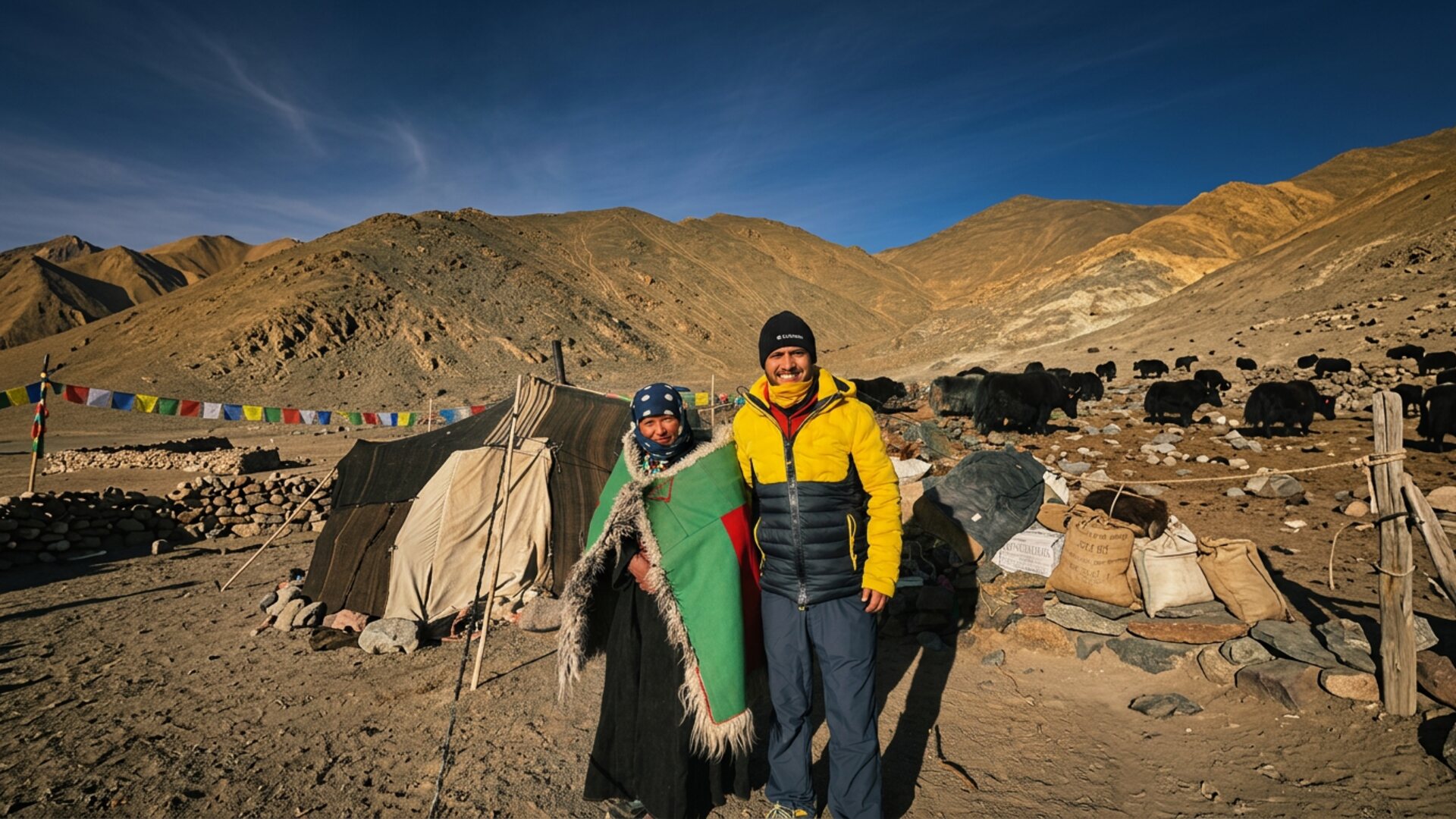
Most travellers meet Pashmina at the soft end of the story. The real beginning is much harder. It lives in the wind-struck plateau of Changthang, where the Changpa move with their herds through one of the harshest inhabited landscapes in India.
The Changpa are pastoral communities of eastern Ladakh, closely tied to high-altitude grazing and the care of Changra goats whose underfleece becomes Pashmina. To visit that world well is to understand that luxury in the Himalayas often begins in labour, climate knowledge, and ecological restraint rather than in anything polished or urban.
Why the Changpa story changes the trip
A Changpa-focused route is not only about wool. It is about movement, weather, camp logic, pasture, and a life built around altitude rather than convenience. The beauty of Changthang comes partly from how little the land forgives. That is why the human intelligence required to live there deserves more attention than the fibre the outside world extracts from it.
The details that still make Changthang feel alive
- A pastoral life still shaped by seasonal movement and high-altitude grazing rather than fixed valley routine.
- The origin point of Ladakh Pashmina, one of the most distinctive luxury fibres associated with the Indian Himalaya.
- A landscape where wildlife, livelihood, and climate pressure all sit dangerously close together.
- A chance to understand eastern Ladakh through herders and camps, not only through road-mapped viewpoints.
When this journey feels most worth doing
The broad travel season is late spring to early autumn, when access to eastern Ladakh is easier and long plateau drives are practical. What matters more than a single month is route design. Changthang should be entered after proper acclimatisation, not treated like a day trip from Leh.
What Changthang gives you beyond the obvious
The strongest version of this journey is rarely the one that tries to see the most in the least amount of time. It is the one that allows Changpa life in Changthang to become legible through repetition: one more walk, one more meal, one more conversation, one more hour spent noticing how the place holds itself when nobody is trying to impress you.
That is usually where the copybook idea of culture falls away and the real thing begins. You stop looking for a headline and start noticing pattern, mood, labour, and social intelligence. In Himalayan travel, that shift is often the difference between a pleasant route and a memorable one.
Why Changpa landscapes should not be consumed too quickly
Most travellers get this wrong in the same way: they arrive with a collecting instinct. They want one clean explanation, one culturally satisfying photograph, one short answer to what this region means. But Changthang is not built to reward that kind of speed. It asks for sequence, patience, and enough humility to let local life stay larger than your interpretation of it.
- Do not treat Changthang as a rare detour whose job is to deliver proof of authenticity.
- Do not confuse visual difference with cultural understanding.
- Do not let road ambition erase the slower social texture that makes Changpa life meaningful in the first place.
Travel like a guest, not a collector
Do not go to Changthang expecting an easy cultural performance. Give the route time, build altitude gradually, and work with people who understand camp distances, weather shifts, and local sensitivities. If you are buying Pashmina along the way, ask where it began and who actually benefited from the chain.
For travellers who care about quality, the real upgrade is subtle. Better timing, fewer unnecessary stops, stronger local hosting, and more emotional space create a route that feels calmer and far more expensive in the right way. That is especially true in Changthang, where the atmosphere improves the moment the itinerary stops trying to prove itself.
Trips that pair well with this cultural angle
- Changthang and Nubra Route: A strong fit if you want eastern Ladakh to feel lived-in, expansive, and culturally grounded.
- Umling La Expedition: Best for travellers who want the high plateau as a serious road experience, not a surface-level add-on.
Travel questions
Who are the Changpa of Ladakh?
The Changpa are pastoral communities of the Changthang region in eastern Ladakh, known especially for high-altitude herding and Pashmina-linked livelihoods.
Is it possible to experience Changpa culture while travelling in Ladakh?
Yes, but it should be done through a properly paced eastern Ladakh route rather than a rushed stop designed only for photographs.
What is the connection between Changpa people and Pashmina?
The Pashmina story begins with the Changra goats herded by Changpa pastoralists on the Changthang plateau.