Spiti Valley Road Trip Itinerary
A strong Spiti Valley road trip itinerary should feel intimate rather than overstuffed. Spiti rewards travellers who let the valley unfold through villages, monasteries, and road rhythm instead of rushing every headline stop.
By Himalayan Locals Editorial Team
A good Spiti Valley road trip itinerary should feel like a valley journey, not a race between icons. Spiti is one of those regions where the route gains more power the slower it becomes. The village rhythm matters. Monasteries matter. The transitions between barren ridges, cultivated pockets, and high road sections matter. If you try to turn Spiti into a checklist, the valley quickly loses the intimacy that makes it so rewarding.
That is why the best Spiti itineraries are built around coherence rather than mileage. You want the route to open naturally, deepen through cultural texture, and carry enough margin to let the valley feel lived-in instead of consumed. Whether you are doing a classic circuit, a premium small-group journey, or a private road trip, the underlying principle stays the same: each day should add emotional value, not just more distance.
Spiti is stronger when every day has one identity
The cleanest Spiti Valley road trip itinerary usually moves through a sequence of moods rather than only locations. One day is an opening road day. One is for the monastery-and-village world. One is for deeper valley exploration. One is for the stronger scenic transition. One is for closure. When planned this way, the trip feels like a story. When planned badly, it feels like a stack of forced wake-up calls and partial experiences.
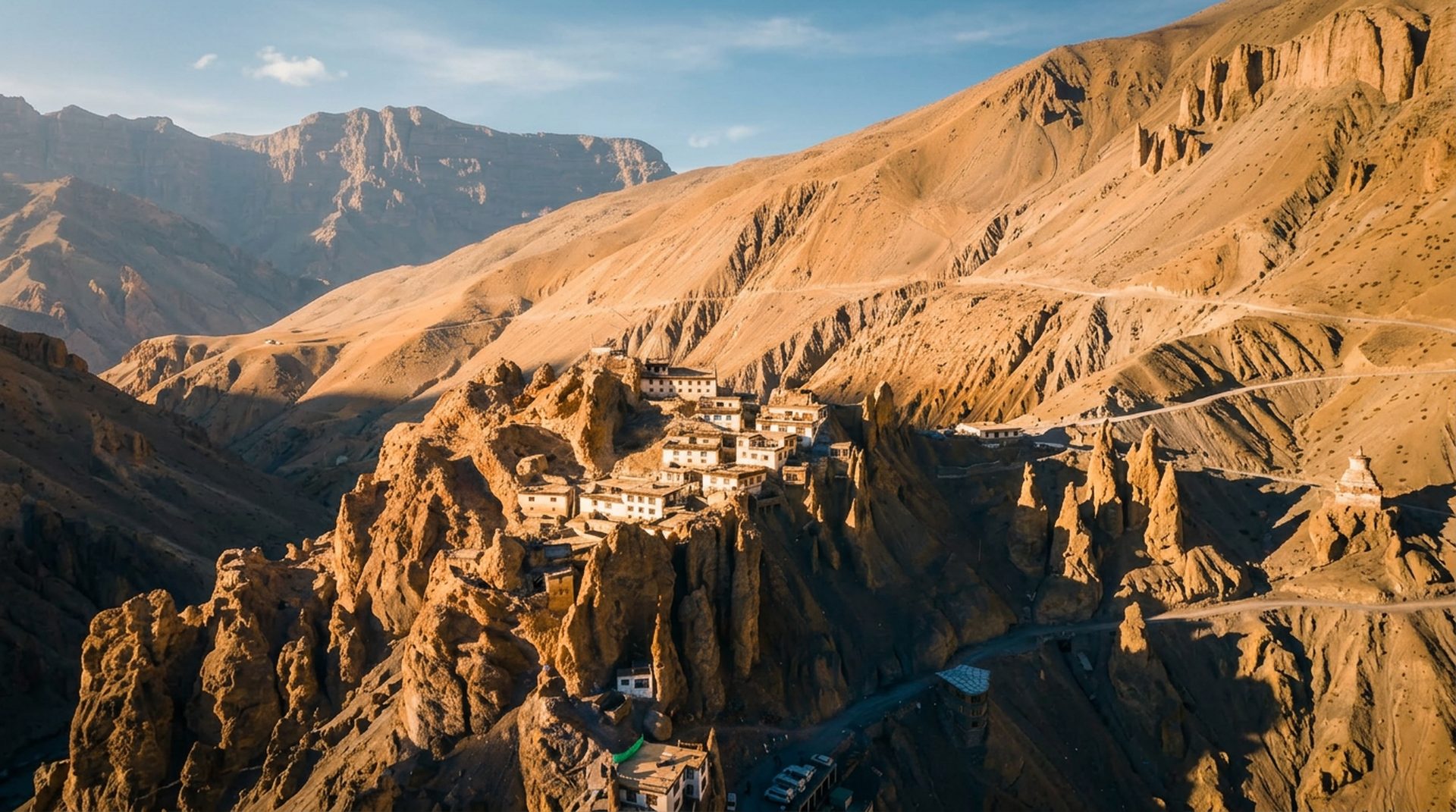
A premium-friendly Spiti Valley road trip itinerary
Day 1: Enter slowly
Let the first day establish the road mood without asking it to do too much. A strong opening gives you landscape transition, one meaningful halt, and enough recovery at the stay to begin the route in a good emotional state.
Day 2: Monastery and village texture
Use this day to move deeper into the cultural grammar of the valley. Monastery stops, village scale, and slower walking sections help Spiti stop feeling abstract and start feeling inhabited.
Day 3: Valley depth
This should be the day when your itinerary stops proving and starts listening. Spend the day deepening one section of Spiti rather than constantly trying to expand the map.
Day 4: Scenic high point
A major visual chapter or road transition belongs here, once the route already has emotional grounding behind it. The impact becomes greater because the valley has already taught you how to read it.
Day 5 onward: Close with space
The final phase should not be all extraction. It should give the route enough room to settle. Closing mornings and transitional road days are part of the itinerary, not dead time between highlights.
Spiti gets better when you remove pressure
- Fewer hotel changes and fewer days trying to do too much.
- More space around monastery stops and village walks.
- One or two strong scenic anchors rather than many weak ones.
- A route that values stillness and atmosphere as much as movement.
The best Spiti Valley road trip itinerary does not promise everything. It promises the right things, in the right order. That is also what makes Spiti premium when it is done well. The valley does not need extra polish. It needs intelligent subtraction. Remove the panic, remove the unnecessary distance, and what remains is often one of the most sophisticated road journeys in the Himalayas.
A trip that reflects this Spiti rhythm
- Spiti Chandratal Trails with Locals: Built for travellers who want a paced Spiti route with village texture, monastery depth, and clean road logic.
A strong Spiti itinerary leaves room for the valley to be subtle
That subtlety is what most rushed itineraries miss. Spiti is not only about drama. It is also about intimacy, repetition of landscape, prayer spaces, roadside pauses, and the way the valley gradually earns your attention. Design your itinerary for that, and Spiti becomes far more memorable than its map would suggest.
The route should feel spacious enough to absorb surprise
One of the clearest signs of a strong Spiti Valley road trip itinerary is that it can survive small changes without losing its shape. Weather can shift. A village stop may deserve more time. A monastery visit may become the emotional centre of a day you thought was about the road. Good itineraries have enough margin to allow that. Weak ones collapse the moment the valley asks for anything unplanned.
This matters particularly for travellers who want Spiti to feel premium rather than merely efficient. Premium mountain travel is often the art of giving meaningful moments somewhere to land. If every day is already packed beyond reason, those moments have nowhere to go. The route may still function, but it will not feel generous.
When in doubt, simplify. Spiti does not need more volume to become memorable. It needs a clearer thread running through the journey from beginning to end.
That thread is what allows even a short itinerary to feel complete. You do not need to prove everything in Spiti. You need to understand what the journey is trying to be and let each day support that idea. When that happens, the valley begins to feel coherent in a very satisfying way. The traveller leaves with a memory of a lived road, not just a string of names.
This is also the point where a Spiti itinerary starts to feel premium. Not because it adds more, but because it removes confusion. The route knows what it is doing, the transitions feel deliberate, and the traveller is not constantly being asked to recover from the plan itself. That calmness is one of the most valuable luxuries a mountain itinerary can offer.
When the route reaches that state, even familiar monastery and valley moments begin to feel more original. Coherence amplifies everything. That is why a well-built Spiti itinerary can feel far richer than a busier one.
That richness is what most travellers are actually searching for, even if they first describe it as wanting to see more. In Spiti, seeing better almost always matters more than seeing more.
A strong itinerary honours that truth from the first road day to the final one.
Once that happens, even a modest route can feel complete in a way that a busier route rarely does.
That is the real measure of success.
When to plan a Spiti Valley itinerary
Spiti is usually best planned from late spring into autumn, when roads are easier to read and the valley can unfold without every transfer becoming a weather negotiation. The exact best period depends on whether you are entering through a classic circuit or choosing a more focused valley approach.
Clockwise or simpler valley flow?
The best Spiti route depends on time, road conditions, and how much transition you actually want. Some travellers love the full sense of entering and exiting through different mountain moods. Others do better with a cleaner in-and-out valley structure that gives more time to monasteries, villages, and atmosphere.
Permits, weather, and stay style
- Permits are usually less central than route practicality, but always confirm if your exact circuit has any restricted segments.
- Weather can transform a reasonable road day into a draining one, so keep a little cushion in the plan.
- Village stays and smaller properties often reveal Spiti better than generic transit hotels.
- Choose overnights that shorten difficult drive days rather than only chasing views.
What keeps the itinerary comfortable on the ground
An SUV with a competent mountain driver is the easiest fit for most private and premium Spiti itineraries. Even when the route is not as immediately high as Ladakh, Spiti still punishes rushed planning. Altitude, road curves, long transfers, and dry mountain air all build cumulative fatigue.
A 6 to 8 day Spiti itinerary that feels coherent
- Day 1: Reach the valley gateway and keep the day measured.
- Day 2: Move inward with one serious cultural or scenic stop.
- Day 3 to 5: Build around Kaza-side depth, villages, and monastery rhythm.
- Day 6 onward: Add one higher scenic chapter or begin the return before the route starts feeling overpacked.
Travel questions
How many days do I need for Spiti Valley?
For most travellers, 5 to 8 days is a strong range for a road-led Spiti journey that still leaves room for village and monastery texture.
What is the best time to visit Spiti Valley?
Late spring through early autumn is usually the easiest planning window for road-based Spiti travel.
Which vehicle is best for a Spiti trip?
A reliable SUV with an experienced mountain driver is the most practical choice for most travellers.
Is altitude a concern in Spiti?
Yes. Even if the route sometimes feels more gradual than Ladakh, altitude and road fatigue still need to be respected.
Should I do a full circuit or a simpler Spiti route?
Choose based on time and energy. A simpler route can often feel more premium and coherent than a full circuit forced into too few days.