Triund Trek Difficulty: An Honest Guide to the Bhagsu Route
Triund is often sold as easy. It is short, but it climbs steadily on rough ground and ends with a long descent. What the walk feels like, how long it takes, and how to make it comfortable.
By Himalayan Locals Editorial Team
"Easy" is the word you will hear most about Triund, usually from someone selling it. The honest version is that Triund is a moderate walk. It needs no technical skill and suits active beginners, but it climbs almost without pause on stony, uneven ground, and the walk down is harder on the legs than most people expect. Plan for that, and it is one of the most rewarding short treks in the Himalaya.
Distance, height and time on our route
We walk the Bhagsu side of the mountain. The figures below are approximate and assume a steady pace with your guide; your own time depends on fitness, weather and how often you stop for the view.
| Section | Distance · time |
|---|---|
| Bhagsu Square to the cottage, via Bhagsu Waterfall | Approx. 3.5 km uphill · about 3 hours with stops |
| Cottage (approx. 2,300 m) to Triund (approx. 2,875 m) | Approx. 2.5 km uphill · about 2 hours with short stops |
| Triund back down to Bhagsu | Approx. 7 km downhill · about 4 hours with breaks |
| Total on foot over two days | About 13 km |
Why we start at Bhagsu Square
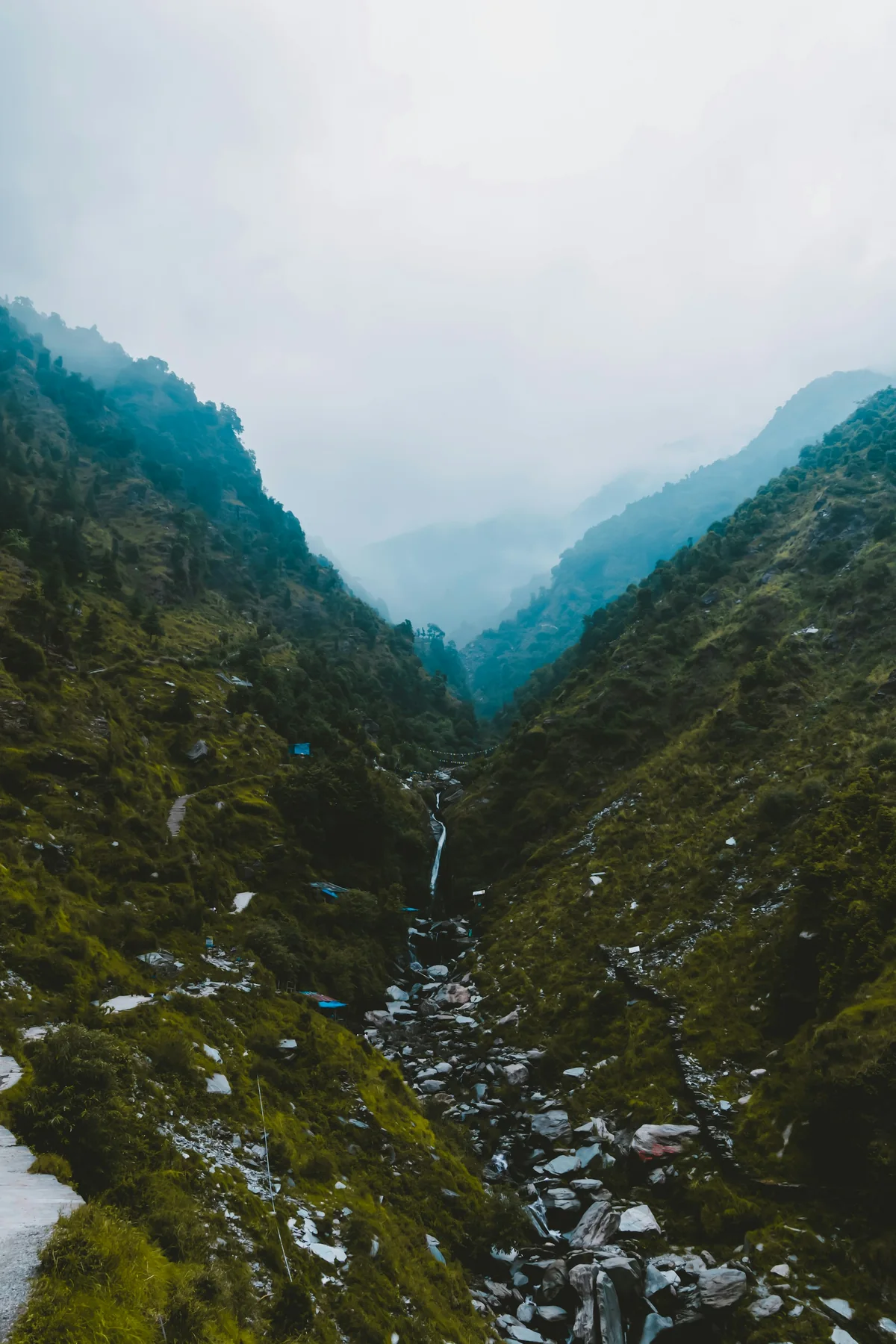
Most day-hikers start from the Galu side above Dharamkot. We start at Bhagsu Square and climb past Bhagsu Waterfall on an old local route. It is about 2 km shorter than the usual trail and noticeably quieter: fewer groups, fewer tea stalls, more forest. The first stretch to the waterfall is busy with visitors from town; beyond it, the path becomes a proper mountain trail of stone steps, roots and loose rock under oak and rhododendron.
What makes Triund feel harder than it looks
- The gradient is steady. There are very few flat sections in which to recover, so pace matters more than speed.
- The surface is stony and uneven. Loose rock and polished steps become slippery after rain, frost or snow.
- The descent is long. Seven kilometres downhill after a summit morning is tiring on the knees and thighs, and it is where most slips happen.
- Weight on your back. A heavy rucksack is the single most common reason first-timers struggle.
- Weather. Cloud can roll in quickly, and the ridge is exposed to wind and cold even when town is warm.
How to turn a hard day into two good ones
The biggest change you can make is to split the walk. Doing Triund up and down in a day means one long effort; sleeping at a cottage partway up turns it into an afternoon climb and a morning climb, with a warm room in between. You reach the ridge fresh, early and with time to enjoy it.
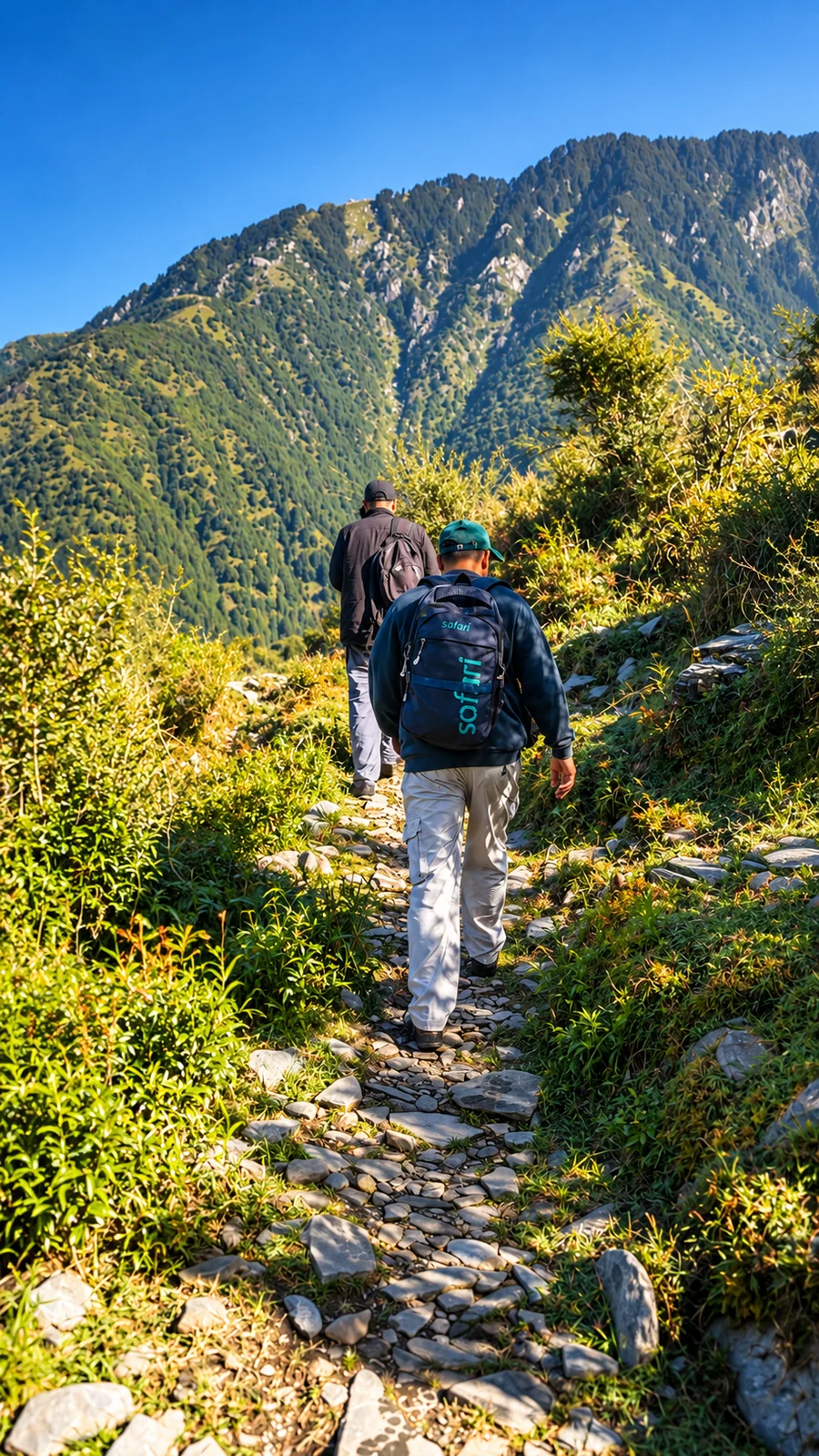
On our private trek, your dedicated guide carries up to 5 kg of your things, so you walk with a light daypack. Trekking poles are provided; use them, especially on the way down. Before the trek, we meet you at your hotel in McLeod Ganj to go through footwear, layers, the weather forecast and the pace that suits you.
What to wear and carry
- Trekking shoes with good grip and ankle support. Smooth-soled trainers are the biggest avoidable risk on the descent.
- Layers: a breathable base, a fleece or light down jacket, and a waterproof shell.
- A warm hat and gloves, even in spring and autumn; the ridge is colder than town.
- Sunglasses, sunscreen and a cap for the open sections.
- Personal medicines and a small amount of cash.
- A refillable water bottle. Drinking water is included on our trek.
How the time of year changes the walk
Spring and autumn usually give the most comfortable walking, with clearer views and drier trails, though no date guarantees either. The monsoon, broadly July to mid-September in the Kangra region, brings rain, mist and slippery paths. In winter, snow and ice can reach the upper trail and the ridge; a heated room at the cottage helps indoors, but it does not change conditions outside, and your guide may turn back if the trail is unsafe.
Reaching the summit is never guaranteed. Weather and trail conditions decide the day, and a good guide will change the plan rather than push on into danger.
Prefer to take it slowly, with a warm room halfway up? See the private Triund trek with a heated cottage stay.
More planning: Where to Stay on the Triund Trek · Triund Trek for Couples
Plan your private Triund trek
- Premium Private Triund Trek & Heated Cottage Stay · 2 days / 1 night: A dedicated guide, a bukhari-heated cottage room 2.5 km below Triund, mountain cottage meals and McLeod Ganj hotel pickup. Couple ₹12,500, solo ₹7,000, small group ₹5,000 pp, plus 5% GST.
Travel questions
Is Triund suitable for first-time trekkers?
Yes, for active beginners with reasonable fitness. Expect a steady climb and a long descent on uneven ground, wear proper trekking shoes and let a guide set the pace.
How long does the Triund trek take from Bhagsu?
On our route, about three hours from Bhagsu Square to the cottage (approx. 3.5 km), about two hours from the cottage to Triund (approx. 2.5 km), and about four hours back down to Bhagsu (approx. 7 km).
How high is Triund?
The Triund ridge is at approximately 2,875 m. Our cottage is at roughly 2,300 m.